The QuickCam and Unconventional Imaging Astronomy Group was founded in 1998 as a forum for discussions about using unconventional devices for principly astronomical purposes.
The "QuickCam" was one of the first such "webcams" used for this purpose. Discussion in the group is not strongly regulated, and topics can vary wildly from the initial remit.
https://groups.yahoo.com/group/QCUIAG
Other sources related to the group
Email to QCUIAG@yahoogroups with your regular mail client and attach the picture. To conserve bandwidth for our dialup members, keep the max size to 75 KB and use JPG with high compression for images. Group members receiving individual emails will receive complete messages with attachment in their email inbox. You cannot see attachments on the group's website, therefore it is nice to put your image on a website and post an link to the image. Keep links short using a service like https://tinyurl.com
Try to be informative - tell the us at least the following, because you'll only get asked it: Date? Telescope? Mount? Filters? Location? How Many Frames? Camera settings?
Information like this adds a lot of value to your images.
For many years the best cameras were the Toucam (or older vesta) cameras from Philips. Only the top of the range model (the older 740k and 840k and the new SPC 900NC ) comes with a CCD chip. (see below).
Recently the logitech fusion webcam (CMOS) has been giving good results and further testing is encouraged!
CMOS Stands for Complementary Metal Oxide Semiconductor. CCD stands for Charged Couple Device. These are the two principle technologies used to make the image sensing part of any digital camera. For a long time CCDs were vastly superior to CMOS, although it seems CMOS technology is catching up fast.
Broadly speaking, astro-imaging uses 6 different cameras:
QCUIAG traditionally discusses the use of the first two.
A webcam adapter is a 1.25" adapter that screws into the camera house instead of the camera lens. The 1.25" barrel and camera replaces the telescope eyepiece. The adapter is often referred to as a "Mogg adapter" after Steven Mogg who first produced them. You can still buy Mogg adapters from Steven Mogg.
Webcam adapters are also available from many telescope dealers.
To image the planets and the moon, all you need is a webcam adapter. For deep sky imaging, it is necessary and possible to modify a webcam to allow longer exposures than the native drivers allow. It is also possible to change the CCD sensor in the camera. SC Stands for "Steve Chambers" - the chap who invented the whole idea
http://www.madpc.net/~firmament/astro/cameras.html (page no longer available)
By holding a soldering iron with a steady hand and visiting Steve Chambers website
A modified webcam is great for deep sky imaging or autoguiding.
Commerical versions of modified webcams are available from
By reading a tutorial:
http://www.madpc.net/~firmament/ (page no longer available)
There are many popular programs to choose from. One of the most popular is K3CCDTools by Peter Katreniak
This program can be used for both capture and processing. Another popular program for processing only is Registax. (http://registax.astronomy.net/ - page no longer available)
A review of popular popular webcam astronomy software. (http://www.madpc.net/~firmament/astro/software.html - page no longer available)
If you take a single picture with a camera it appears noisy. This is due to thermal and electronic effects in the camera, and is also due to the small amount of light available.
It is possible to reduce the noise and increase the depth of the image by stacking many similiar frames taken in quick sucession.
http://webpages.charter.net/darksky25/Astronomy/stacking/stacking.html
When you remove the webcam lens you normally remove the IRB-filter. To improve Colour rendition and focus, an IRB-replacement filter is used. Robin Leadbeater has an expansive FAQ on the issue. Not to be confused with an IR pass filter. These are available from many astronomy dealers and block out all visible light, letting only the infra red through. These are used by advanced imagers to combat poor seeing.
There are many other types of astrophotography filters, such as light pollution, narrowband, etc. Any astrophotography filter can be used with a webcam, but your mileage will vary. Experiment Experiment Experiment.
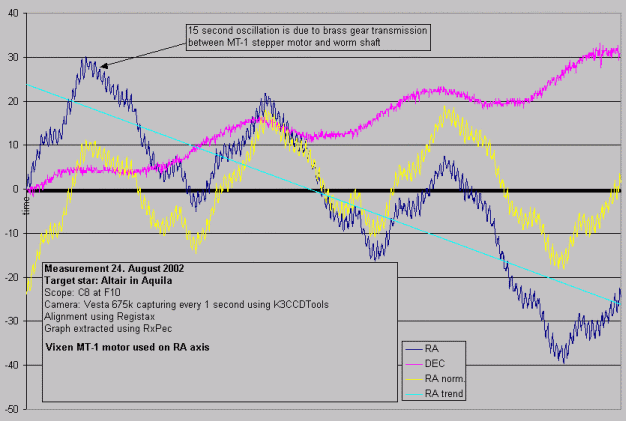
Almost all mounts have "periodic error" due to mechanical tolerances in the mount. This causes inaccurate tracking that affects long exposures eg https://arnholm.org/astro/da1/pe_mt1.gif
Autoguiding is the process of monitoring a star and making correction to the mount so that the mount tracks the sky properly during long exposure imaging.
http://www.store.shoestringastronomy.com/EssentialsOfWebcamAutoguiding.pdf
/articles/autoguiding/tracking_autoguiding.html
Martin Burri's WcCtrl works with several cameras and offers ways of saving and loading settings and is generally much easier to use than the built-in camera setting dialogs
A simple firmware modification that improves image quality by bypassing unwanted in-camera processing
Raw mod homepage and software
AviRaw Software tool
Raw Mod Introduction